
The main objectives of test-firing were to validate safe separation of the missile from the parent aircraft, effect of missile plume on engine air-intake, functionality of store management system, including safety interlocks, effect of missile plume on composites structures and handling quality assessment during missile launch.
Pakistani President Arif Alvi and Prime Minister Imran Khan conveyed their appreciation to the team, and congratulated the nation on the feat.

Earlier, United States Secretary of State Rex Tillerson urged the international community to increase pressure on North Korea, saying that failing to do so would bring 'catastrophic consequences'.

'Government officials use Gmail and ordinary phones without basic security consciousness.' 'Interoperability, especially in joint exercises with countries like the US, worries me.' 'It often means we open our systems to them, but they don't reciprocate.' 'They could have kill switches in their systems and might even be able to affect ours.'

Modi has in the past taken to addressing the nation to make major announcements, like demonetisation in 2016 or India's successful test of Anti-Satellite Missile to join an elite club of countries in 2019.

After Operation Sindoor, the Army and Navy now view the IAF as not a supporting arm, but the spearhead of India's warfighting capability, capable of decisive outcomes across domains, explains Air Commodore Nitin Sathe (retd).

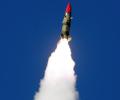
Pakistan on Friday successfully test-fired the medium-range Shaheen-III surface-to-surface ballistic missile which can carry nuclear warheads within a range of 2,750 kms, the military said.
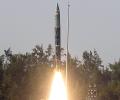
Ahead of Republic Day, the Indian Army announced on Thursday the addition of two new features to this year's parade: battlefield surveillance systems and a Defebce Research and Development Organisation tableau showcasing Pralay, short-range ballistic missiles.

Russian President Vladimir Putin is expected to visit India around December 5 to hold annual summit talks with Prime Minister Narendra Modi to further solidify bilateral strategic ties.
This was the second missile test carried out by AFSC this month.

'Pralay' is a 350-500 km short-range, surface-to-surface missile with a payload capacity of 500-1,000 kg. The solid-fuel, battlefield missile is based on the Prithvi Defence Vehicle.

China has said that it successfully carried out a land-based mid-course anti-ballistic missile (ABM) technical test on Sunday with Chinese experts claiming that the tests, stated to be the sixth of its kind, validated the reliability of the country's anti-ballistic missile umbrella.
The missile is a new version of an existing nuclear capable missile.

The test firing validated the capability to engage the weapon as an anti-ship missile

The weapon system is customised to operate in altitude above 4,500 metres and has latest upgrades including indigenously developed Radio Frequency seeker, as per the release.
Defence sources said two rounds of 'Pinaka' were test fired between 1215 IST and 1245 IST.

North Korea on Wednesday test-fired a ballistic missile towards the Sea of Japan.
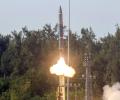
The solid-fuel, battlefield missile developed by Defence Research Development Organisation is based on Prithvi Defence Vehicle from the Indian ballistic missile programme.

With new added technologies, including the control system, the missile was test-fired from the Integrated Test Range (ITR) launch pad-III at Chandipur around 10.45 am, said a source at the Defence Research and Development Organisation.

This firing is a significant step towards achieving self-reliance in niche missile technology. Navy said.

Pakistan on Wednesday successfully test-fired a new ballistic missile which is capable of carrying both conventional and nuclear warheads up to a distance of 1,300 kilometres.
India on Saturday successfully test-fired indigenously developed ballistic missiles 'Prithvi-II' and 'Dhanush' from different locations off the Orissa coast, adding more firepower to the armed forces.

Or will he just repeat what we all know on the new GST rates - worked out under desperation and which become effective tomorrow?" Congress leader Jairam Ramesh said.
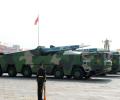
China might one day be able to launch a surprise nuclear attack on the United States, the second highest-ranking American military officer has warned as he shed new details of Beijing's hypersonic weapons test in July, which sent a missile around the world at more than five times the speed of sound.

The Ababeel missile brings many Indian cities within its range.
Amid heightened tensions between India and Pakistan, authorities in Delhi are taking precautionary measures, including installing air raid sirens, conducting mock drills, and deploying civil defence personnel. Security has been beefed up at vital installations and areas with high footfall, while the government has barred its employees from going on leave.

The defence ministry said the test-flight was carried out on Wednesday evening and it met all the trial objectives, validating the reliable performance, as confirmed from the data captured by a number of range sensors deployed at different locations.
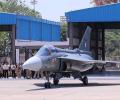
HAL has assured the IAF that 12 Mk1A aircraft will be delivered by the end of 2025-2026.
Pakistan on Tuesday conducted a surface-to-air missile test, its second such drill in four days in a bid to add "offensive punch" to its forces, according to the navy.

Defence Minister Rajnath Singh on Sunday said that the Brahmos missile proved instrumental in Operation Sindoor and since then, more than a dozen countries have expressed interest in it.

'Agni Prime', the new-generation ballistic missile, was successfully flight-tested from an island off the Odisha coast on Thursday, officials said.
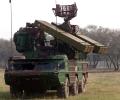
The Indian Army is conducting field trials of several cutting-edge defence systems under 'near-combat conditions', integrating electronic warfare simulations, to assess their performance rigorously, officials said on Saturday.
Pakistan on Saturday test-fired a long-range ballistic missile capable of carrying nuclear and conventional warheads and hitting targets within India. The test-firing of the Shaheen-II or Hatf-VI surface-to-surface ballistic missile the first missile test since Pakistan's new government assumed office last month was witnessed by Prime Minister Yousuf Raza Gillani.

The QRSAM system is unique in its ability to operate on the move, searching for and tracking enemy targets; and then fire on a short halt.
"Agni-1, surface-to-surface single stage missile with 700 km range, will be taken up for test on Sunday," sources said, adding that Defence Research Development Organisation and operational strategic units of army and naval forces would jointly conduct the operation.

The missile test was carried out from a mobile launcher from launch complex-3 of the Integrated Test Range at about 10 am, defence officials said.
KCNA said the new type of surface-to-ship cruise missile is designed to hit 'any enemy group of battleships' that threatened the country.

The MiG-21's sharp silhouette and supersonic roar will live on in the memories of those who flew it, those who maintained it, and those who watched it streak across the sky as a symbol of India's strength, asserts IAF veteran Air Commodore Nitin Sathe (retd).

The defence ministry said the missiles destroyed the targets with precision at two different ranges.

The surface-to-surface Prithvi-II missile is capable of carrying 500 kilogram to 1,000 kg of warheads and is thrusted by liquid propulsion twine engines
